Thursday, 15 May 2008

Converts to the clan of collectors!

Oh how I love compliments! Thanks to "Jules and Andy" who posted this email:

Hi Chris

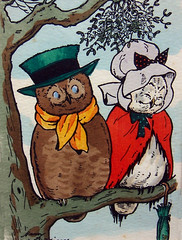
Just recently my partner and I made our first ever auction purchase on a picture of two quirky little owls.  We fell in love with it straight away but had no idea who the painter was.  After acquiring this little treasure we began to research it to find out more about it.  We came across your article on H B Neilson and were warmed by your enthusiasm for his work.  We now believe it to be one of his pieces and just wanted to send you a photograph of the picture in gratitude for all the research you have done on Harry and of course show that people still do appreciate his talent (even though we had no clue who he was!).

Thank You

No, Jules and Andy, thank you! . Read about Harry Neilson here - perhaps you'll catch the collecting bug.

Labels:

Friday, 27 July 2007

Life and times of a comic genius

A couple of weeks ago, I wrote in passing about eccentric Edwardian artist Harry B. Neilson (pictured right) – the man who painted those charming watercolours of foxes dressed as huntsmen riding foxhounds. As far as I was concerned, the artist was something of an unknown.

I said I intended to learn more about him and added that I would appreciate hearing from any reader who could help me give Harry his rightful place in the roll call of gifted local artists whose lives and work should be memorialised. Needless to say, I was overwhelmed by the response.Read more »

Labels: ,

Thursday, 26 July 2007

Merseyside’s forgotten artists

Learning about antiques and fine art continues to fascinate me and I feel like I'm on a never-ending journey. Two things happened this week to set me off in a new direction. Both involve the work of local artists.

First, I heard I talk by a museum and art gallery curator about the life and work of the Herdman family of painters and second, an auction catalogue dropped through my letterbox with one of the most amusing front cover illustrations I've seen in a long time.Read more »

Labels: , ,

Monday, 23 May 2005

Fine art: painting that keeps up with the Joneses

Español | Deutsche | Français | Italiano | Português

Thomas Jones Italian view
By Christopher Proudlove©

One day, I'll write about the fortunes of a forgotten artist who will suddenly be rediscovered and lauded by art historians far cleverer than I'll ever be. I'm not holding my breath!

Longstanding readers will know how keen I am. In these pages I've already reminded both them and myself about Liverpool's Herdman family of watercolourists; Birkenhead artist Harry B. Neilson, (1861-1941); Liverpudlian artist, George Haydock Dodgson (1811 - 1880) and Wallasey-born Frances Macdonald.

I thought I was on to something when the respected dealer and fine art agent in Old Master and British paintings, Ben Elwes, contacted me to tell me about a rare picture by a previously little known Welsh artist which he has for sale.

Clearly the work is important. Not only was the picture, illustrated here, the star piece in his new gallery at 45 Maddox Street, but Elwes also unveiled it at the International Fine Art Fair in New York last week at an asking price of £70,000. It went down well and sold shortly after the fair opened.

It was painted by Thomas Jones of Pencerrrig (1742-1803) of whom few had heard until major exhibitions were mounted at the National Museum and Gallery, Cardiff, the Whitworth Gallery, Manchester, and the National Gallery in London, marking the bicentenary of his death.

If that wasn't enough, a beautiful book titled "An Artist Rediscovered" was published to coincide with the exhibitions, co-edited by Ann Sumner, the curator of fine art at the National Museums and Galleries of Wales, and Greg Smith.

Although Jones was a talented landscape artist, until then little had been written about his life and work and many of his paintings had never before been published.

That was quickly resolved. In addition to essays by leading Jones scholars the book was illustrated by more than 150 paintings from throughout the artist's career, many of which were being seen by a wider audience for the first time. Curses - beaten to it again!

Actually, I was 50 years too late. It was about then that Jones' memoirs were rediscovered and published (by the Walpole Society), leading eventually to him being recognised as a major artistic personality where previously he had been all but forgotten.

The memoirs were never written for publication. They were, as he wrote at the time, "from short hints and Memoranda of a Diary, which for many years I had been in the habit of keeping, the original Intention only for the Amusement of vacant hours and the Perusal of a Few".

Most comprehensive memoirs

But they are the most comprehensive memoirs of any artist of the time and they make fascinating reading.

Jones was a "gentleman artist". He was the second of 16 children (seven of whom died in childhood) whose parents, Thomas and Hannah Jones, were landowners in Trefonnen, Radnorshire.

His mother inherited a house and estate in Pencerrig, near Builth Wells, and he was educated at Christ College, Brecon, and Jesus College, Oxford, destined for a career in the Church.

However, the death of his wealthy uncle, John Hope, who had been financing the young man's education put paid to that ambition and rejecting the idea of going to sea -- the other career for the younger sons of the landed gentry -- he managed to persuade his parents to let him train to be an artist.

At the age of 19, he enrolled at William Shipley's Drawing School in London, where he became a pupil of fellow Welsh artist Richard Wilson, but "copying drawings of Ears, Eyes, mouths & Noses" among "little boys of half my age" was humiliating for Jones.

But he was a quick learner. By 1766, he had been elected to the Society of Artists, the year after Gainsborough.

Although not really needing to make a living from painting, Jones became a professional artist, returning to Wales 10 years later.

However, like many other young artists of the period, he was desperate to travel abroad and like Wilson, Jones was determined to tour Italy. In those days it took a month to get there and he arrived in Rome towards the end of 1776.

In his memoirs Jones calls the city a "magickal land" and he remained there for almost two years before visiting Naples, socialising all the time with an expat British community of artists and patrons.

A series of small oil-sketches, painted during this time have been described as masterpieces of observation but after six years, Jones became homesick for his native land and returned in 1782 having heard that his father had died.

He took with him his lover, a Danish widow named Maria Moncke, and their two young daughters, a situation which must have caused raised eyebrows, despite her passing herself off as his housekeeper. They later married and settled in London with Jones receiving an annual income from his inheritance.

His elder brother, Major John Jones, a bachelor, died in 1787 and the artist found himself required to return to and take over the running of the family estate at Penkerigg near Builth Wells.

In addition to tracts of land, the family also owned Llandrindod Hall in Llandrindod Wells, which was let out as a hotel, as was his father's family home, Trefonnen, all of which provided an annual income of £4,000 and a comfortable lifestyle for Jones and his family.

His anger at discovering that drawings he had left in London during his visit to Italy had been ruined was eventually forgotten and he busied himself making oil and watercolour sketches of the surrounding Radnorshire countryside.

Entering fully into the local society, he was appointed High Sheriff of Radnorshire in 1791 and a magistrate the following year. Maria died after a long illness in 1799, a loss which deeply affected Jones, who died at Pencerrig in 1803.

It is interesting to add that when 50 watercolours and oil views in both Wales and Italy by Jones were offered in an auction at Christie's in London in 1954, they were described as "The property of a lady who had whose husband was a descendant of Thomas Jones, a pupil of Richard Wilson, RA".

The sale excited the attention of two of London's most important dealers -- Colnaghi and Agnews -- the most expensive lot selling for £33.12s (£33.60)! The National Museum of Wales was another buyer in the sale and their purchases can be seen there today.

Colnaghi was quickly able to find buyers for its purchases, their customers including the Ashmolean Museum, the Fitzwilliam Museum and the Birmingham Museum and Art Gallery. They were no doubt somewhat cheaper than the work sold in New York last week!

Pictures show, top:
Thomas Jones (British, 1742-1803) A Neapolitan Coastal View from Pozzuoli, painted in 1781. The oil on canvas measures 38.5 X 29 inches (97.8 X 73.6 cm) and is signed and dated lower left: THO:JONES · Ft MDCCCLXXXI A NAPOLI. In a period Italian carved and gilded frame, the work is priced at £70,000
Below:

Family life at Pencerrig was captured in this conversation piece by Jones' friend, the Italian artist Francesco Renaldi (1755-1798). The painting shows Jones with his palette and easel, his wife Maria spinning wool and their two daughters, one of whom is playing the harpsichord. The second man is as yet unidentified and could be one of Jones' brothers or Renaldi himself. In 1797, when the piece was painted, Maria was probably already suffering ill health and Jones was deeply affected by her death two years later. The painting can be seen in the collection of the National Museums and Galleries of Wales in Cardiff

Jones by Renaldi

Labels: ,

Sunday, 10 April 2005

Forgotten artist of true genius

The Welsh Singer

Español | Deutsche | Français | Italiano | Português
by Christopher Proudlove©

At risk of sounding repetitive, regular readers of this column know how keen I am to learn more about the work of forgotten local artists and craftsmen.

With readers' help, we have already uncovered stacks of information aboutLiverpool's Herdman family whose watercolours documented the development of the city in the 19th century (Chapter One); Birkenhead artist Harry B. Neilson, (1861-1941) the man who painted those charming watercolours of foxes dressed as huntsmen riding foxhounds (Chapter Two) and Liverpudlian artist, George Haydock Dodgson (1811 - 1880) who remains elusive despite being a regular exhibitor at among others, the Royal Academy, The Society of British Artists, and The Liverpool Society of Fine Arts (Chapter Three).

The Search continues this week with Chapter Four: who was Wallasey-born Frances Macdonald?

The question was posed when North Wales auctioneer David Rogers Jones contacted me with information about one of his regular "Welsh Sales", which will take place on Saturday, April 23, at his rooms in Abergele Road, Colwyn Bay.

The sale of Welsh views and work by Welsh artists shows no sign of slowing and the sale contains some exceptional lots.

But it is a remarkable painting entitled "The Welsh Singer" by Frances Macdonald that is arousing interest, even before the auction catalogue has been published.

The monumental work -- it measures 6 feet wide by 4 feet deep -- has astonishing wall power. It depicts the vast Penrhyn slate quarry and takes its title from a central figure, a miner who sits head tilted heavenward, singing at the top of his voice while the cacophony of mining goes on all about him.

David Rogers Jones tells me that the work was specially commissioned by the Arts Council of Great Britain for an exhibition which toured the country, finishing at the Festival of Britain in London in 1951.

Leading artists of the era were asked to contribute a painting for the exhibition, which was called "Sixty Paintings for '51". Frances was among their number, as were Francis Bacon, Edward Burra, Lucien Freud, L.S. Lowry, John Nash, Victor Passmore and Ruskin Spear.

In other words, our Frances was among an illustrious gathering, la creme de la creme of Britain's artistic community in the Fifties.

I don't claim to have an extensive reference library, so most of my research is done on the Internet.

Had she been the Frances Macdonald who was one of the so-called Scottish Four - artist and designer Charles Rennie Mackintosh, furniture designer, painter, metal worker, jewellery designer and graphic artist Herbert MacNair and sisters Frances and Margaret Macdonald, the search would have been simple.

Scottish Frances married MacNair and was a renowned artist in her own right producing embroideries, gesso panels and water colour paintings, all in the unmistakable Macintosh style.

But our Frances is virtually anonymous.

However, it transpires that the Tate has two works by her in their collection: "Building the Mulberry Harbour, London Docks 1944" and "Iffley Church" 1970-1, and their excellent website gives a brief but tantalising biography.

It reads: Frances MacDonald 1914-2002. Landscape painter, particularly of scenes in Wales and the South of France. Born 12 April 1914 at Wallasey, Cheshire; her great-grandfather was a portrait painter in Dublin. Studied at Wallasey School of Art 1930-4 and the R.C.A. (Royal College of Art) under Sir William Rothenstein and Barnett Freedman 1934-8. Official War Artist 1940-6. First one-man exhibition at Wildenstein's 1947; has also exhibited at the Alfred Brod Gallery. Married to Leonard Appelbee.

"One-man band"

Fascinating. So, with the unusual spelling of his surname,that must be the same Leonard Appelbee whose painting "One-man Band" was also commissioned by the Arts Council and hung in the same Festival of Britain exhibition.

Fortuitously, the Tate also has works by Apelbee in their collection and his website biography shows his dates as 1914-2000. A painter of landscapes, still lifes and occasional portraits, he was born in Fulham, London, studied art at Goldsmiths' College 1931-4, and at the R.C.A. 1935-8. He saw active service in the Army an exhibited regularly at the Royal Academy.

That would have been all I could tell you, but adding to the intrigue is a letter -- to be sold with Frances' "The Welsh Singer" -- dated 1983 from Sheffield address and written by someone who was clearly an admirer of her work.

The recpient of the letter was Miss S. Davies, the headmistress of Weatherhead High School, Mount Pleasant Road, Wallasey, following a visit to the school in a few days earlier by the sender.

The letter reads: "A few days ago I received a pleasant letter from Frances MacDonald who made some interesting remarks about her painting The Welsh Singer 1951.

"She wrote: 'I was interested to be asked to paint a large canvas, as I was already contemplating a painting of that vast Penrhyn Quarry because it was such a magical and compact shape, like a witches' or Welsh hat and I was bewitched by its poetry and the wealth of music coming from 'the biggest man-made hole in the world'.

"She goes on a great length about the growth of the work and then writes that 'the person who had been music teacher at Wallasey high school bought it for the school'.

"There is a strong chance that Frances MacDonald attended either your school or one in the Wallasey area because she writes that she attended 'the small but very good Wallasey Art School' before going to the Royal College of Art."

The letter concludes by giving a Devon address for Frances and Leonard Appelbee and suggests that the headmistress might well receive a letter from her.

This background information -- the provenance of "The Welsh Singer" -- makes the painting even more compelling. David Rogers Jones believes the work left the school and was sold without fanfare "a year or two ago".

One of about 200 paintings by Welsh artists and Welsh subjects to be sold by him on Saturday, April 23, the work is expected to fetch in the region of £4,000. I suspect it might be more.

And, as usual, if any reader knows more about Frances MacDonald -- perhaps they were a fellow pupil at Weatherhead High School, a neighbour or a friend -- I'd love to hear from you.

60 Paintings for '51
A foreword to the catalogue for the exhibition "60 Paintings for '51", to be sold with "The Welsh Singer" reads: "If the Festival of Britain is to achieve its avowed aim of showing the British way of life in all its various facets it is clearly appropriate that a number of distinguished painters and sculptors should have been given an opportunity to make their contribution.

"With this very end in view -- and also in the hope of handing down to posterity from our present age something tangible end of permanent value -- the arts Council has commissioned 12 sculptors and invited 60 artists to paint a large work, not less than 45 x 60 inches on a subject of their own choice.

"The paintings will be exhibited in London and the Provinces as a group not only to enable visitors to the Festival to see a lively cross-section of contemporary British painting but also to encourage other public bodies, or indeed private individuals too, to celebrate the Festival by making a purchase.

"It will be said, and rightly, that today the number of private patrons who can afford either the wall-space or the cost of these large paintings must be limited and it is to the new collective patrons of the future, as well as to art galleries, that the exhibition is commended as an opportunity when they may suitably exercise their patronage".

The same holds true, both for exhibitions and auctions, today.


Pictures show top:
"The Welsh Singer", the imposing oil by Frances Macdonald
Below, left to right:
Two detail images showing the singer, head tilted heavenward, from whom the picture's title is taken
Detail showing slate cutters at work
The singerThe singerThe slate cutter

Labels:

Saturday, 5 March 2005

The Search for Forgotten Artists - Chapter 3

Español | Deutsche | Français | Italiano


by Christopher Proudlove©

Regular readers of this column - and they are spread far wider than I ever imagined - will know how keen I am to learn more about the work of forgotten artists and craftsmen.

Sometimes, like Liverpool's Herdman family of watercolourists, (the subject of Chapter One of these missives) they are well known and feature prominently in the art history of the region.

Even so, an airing does no harm to any of them. Otherwise people like Jeanette might feel they were on their own.

She emailed me from New Orleans to say that she owns a watercolor/pen drawing by Stanley Herdman dated 1883 or 85 which she purchased when she lived in Dunoon, Scotland.

Her message went on: "I have been unable to find a reference to Mr. Herdman until I read your column [on the internet] tonight. I am thrilled that someone at least knows about him!

"How may I learn more about Stanley Herdman, and in particular, the charming pastoral scene I own? Any information you may share will be immensely appreciated."

I've suggested Jeanette email me an image of the picture and I've offered to help in any way I can.

Then there was Chapter Two of The Search: all about eccentric Edwardian artist Harry B. Neilson, the man who painted those charming watercolours of foxes dressed as huntsmen riding foxhounds and chasing men as their quarry.

As far as I was concerned, the artist was something of an unknown, but I was soon proved wrong.

Several readers responded, including one from Harry's home town of Birkenhead who put me in touch with a member of Harry's family now living in New Zealand.

It turns out that the New Zealander had written a book about the family's history and I was sent the copy now sitting on my bookshelf.

That's the great thing about collecting and appreciating antiques. By doing so, you become part of an international community, the members of which are only too keen to help others.

I learned a good deal of what I know from other collectors who were only too happy to pass on their knowledge, even though it might have taken them personally a lifetime of study and research. Sadly, that selflessness is all too lacking elsewhere.

Which brings me to Chapter Three of The Search.

An email arrived the other day from a Mr Hugh Dodgson, a member of the Crown Service now retired, who tells me he had also "tripped over" my Herdman and Neilson columns whilst doing research on the internet "to keep the grey matter from total atrophy".

He wrote: "I am pursuing an equally elusive Liverpudlian artist, George Haydock Dodgson (1811 - 1880). He is a relative of mine and research through the family papers and the Liverpool Museums - particularly the Walker and Williamson Galleries - is beginning to put a bit of flesh on the few bones of which I know.

"There is much yet to be discovered about his life which remains the objective of my current research. If you come across anything about GHD, I would be very grateful to hear - all help gratefully received!".

So, in an appeal to readers of this column - wherever in the world they might be - in the quest for knowledge and in the spirit of the collecting community, anyone with any information about the artist is asked to make contact with me and I will be happy to put them in touch with Hugh Dodgson.

So who was George Haydock Dogdson?

Hugh Dodgson has a good deal of background information about his relative and was happy to share what he already knows with
WriteAntiques readers.

He writes: George Haydock Dodgson was born at 38 Castle Street, Liverpool. on August 16, 1811. He was the eighth child of Pearson Dodgson and Hannah Haydock who had been married in 1796.

Pearson was born in 1774 and from at least 1800, ran a linen drapery and haberdashers at 38 Castle Street, Liverpool.

This business was maintained until at least 1910 by later members of the family with shops at various dates at St George's Crescent; 192 Grove Street; 28 Duke Street; 2 Lord Street; Cork Street and 40 and 48 Castle Street, Liverpool.

The shop at 192 Grove Street was run by my grandfather, Fred Pearson Dodgson, grand nephew of George Haydock. Although Grandfather met Charles Lutwidge Dodgson (Lewis Carroll) and regarded him as a dead bore no connection has yet been uncovered between the Bridekirk Dodgsons (my family) and the Daresbury Dodgsons (Lewis Carroll'™s family). The name, in any case, is not uncommon in Lancashire and Yorkshire, and there may some connection but it is at best distant.

George was educated locally (I don't know where) and on July 1 1826, was apprenticed to the well-respected Liverpool surveyor, Jonathan Bennison. He completed his indenture on July 1 1831 and left with a glowing report from Bennison. (I have the original indenture).

Many supposedly authoritative sources claim that he was then apprenticed to George and Robert Stephenson, the railway engineers. I have found no evidence that this is so, although there is plenty of evidence that he was employed by them.

His training under Bennison and his obvious artistic abilities led to a number of tasks under the Stephensons involving the surveying and layout of projected rail lines and the production of drawings of the scenery along the routes. He also produced sketches of the various stations, bridges etc associated with the completed lines.

George may have done work on the Liverpool and Manchester after its opening in 1830, but the first line upon which he worked (as far as I can find) was the Whitby and Pickering Railway, which received Royal Assent in 1833 and which was opened in 1836.

He produced several drawings of the beautiful countryside through which the line passed and these appeared as engravings in a book published in 1836 to celebrate the opening of the line.

He appears to have suffered some ill-health during this period and by 1835, he had moved to North London and was living in Mornington Place, Camden.

His main work continued to be for the Stephensons and largely associated with Robert's construction of the London to Birmingham railway. These were published as engravings in a book on the line by Roscoe in 1839.

Like most artists, he seems to have had financial trouble and wrote a neurotic letter to his parents in 1839 asking for money. However, he was increasingly drawn to freelance work and by 1840, he was producing extremely detailed architectural drawings and water colours of buildings in London.

One of these, a very fine painting of St Paul's Cathedral from Blackfriars Bridge, was presented to the Mayor of Liverpool by George's brother Thomas in 1877. It is now in the Walker Art Gallery.

George continued to live in London but travelled quite widely in England producing romantic water colours of scenery in places as far apart as Norfolk, Lancashire and the Gower Peninsula.

Some of his most atmospheric paintings date from the period after 1850, and he appears to have been particularly prolific between about 1860 and 1880.

He was a member of the Royal Water Colour Society from 1848. Several of his works were reproduced in the Illustrated London News, the Graphic and the Cambridge Almanac.

He was a regular exhibitor at the Royal Academy, The British Institution, The Royal Institute, The Society of British Artists, The Liverpool Academy, The Liverpool Society of Fine Arts, and The Liverpool Autumn Exhibition.

In 1877, he was living in at 28 Clifton Hill, St John's Wood, and died there on June 4 1880.

Denby BridgeNewton DaleCattle

Pictures show:
Top
The Brook. A good water colour by Dodgson painted in 1862. This picture has always been owned by Dodgson's successors, having been given to Dodgson's brother, Thomas

Above
Denbigh Bridge - on the London and Birmingham railway near Bletchley. An engraving by Radclyffe after a painting by George Haydock Dodgson 1839.

Newton Dale near Pickering, Yorkshire - a typically romanticised view along the Whitby and Pickering Railway. An engraving from a Dodgson drawing dated 1835

Cattle in a farmyard. An early pencil sketch by Dodgson found being used as packing behind another Dodgson painting when it was reframed. The drawing dates from about 1830.

Labels: